
Reservas diretas vs. matemática OTA: cálculo da receita líquida por quarto disponível (RevPAR líquido)
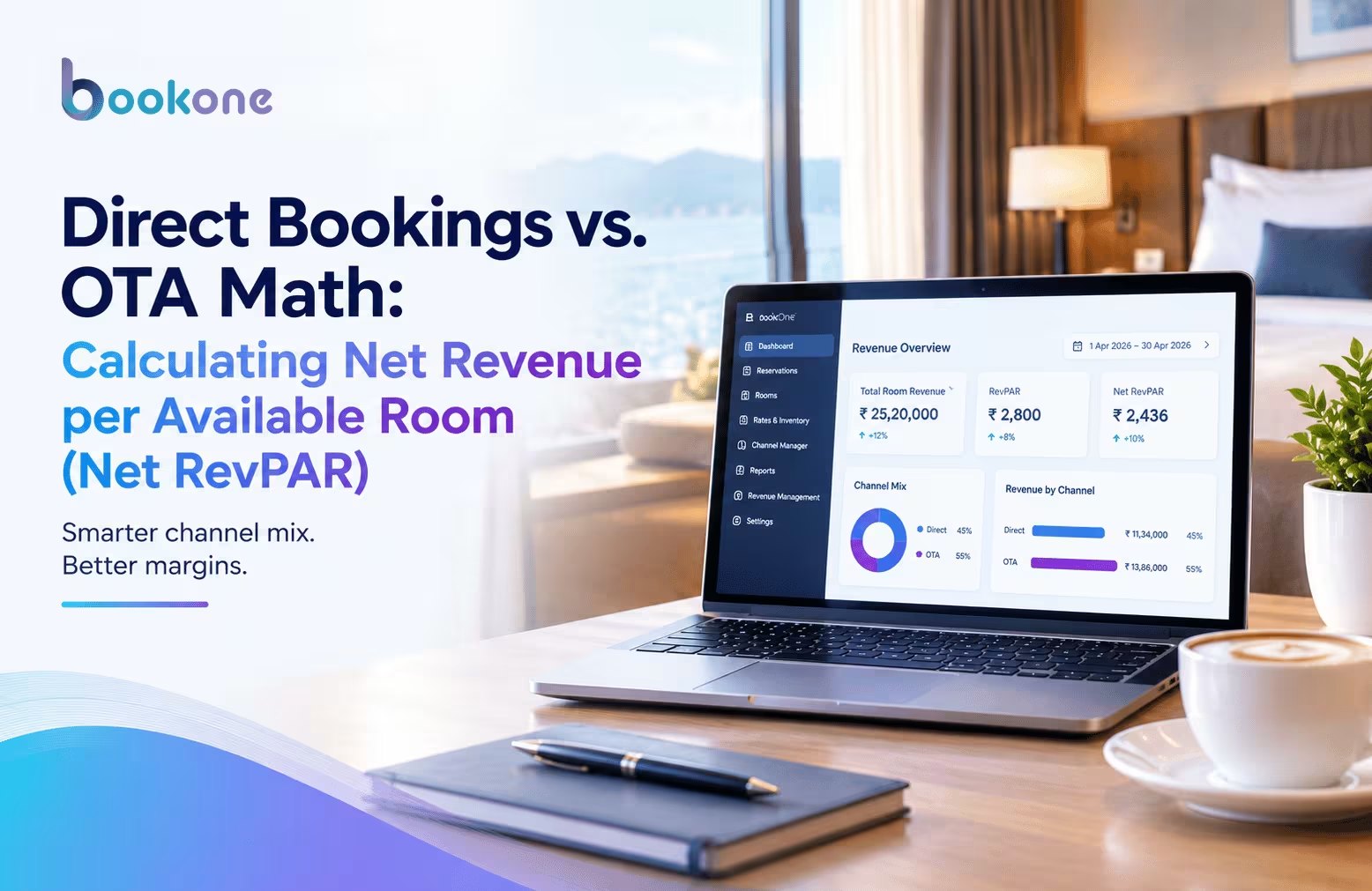
Most small and mid-size hotels in India track RevPAR, revenue per available room, as their headline number. It's a useful metric, but it has a blind spot: it treats a room sold on an OTA at 18 to 25 percent commission the same as a room sold directly at close to full value. Two hotels can report identical RevPAR and be in very different financial positions, depending on how much of that revenue they actually keep. Net RevPAR closes that gap, and for a hotel balancing OTA visibility against direct booking margin, it's the number that should actually drive channel strategy.
RevPAR vs Net RevPAR: What's Different
Standard RevPAR is calculated as:
RevPAR = Total Room Revenue ÷ Total Available Rooms
This tells you how much revenue each room in your inventory generated, on average, regardless of how it was booked. Net RevPAR adjusts for the cost of acquiring that booking:
Net RevPAR = (Total Room Revenue − Distribution Costs) ÷ Total Available Rooms
Distribution costs include OTA commissions, payment gateway fees on OTA transactions, and any wholesaler or travel agent margins. What's left is a much more honest picture of what a room actually earned your hotel, not just what it sold for.
A Worked Example for an Indian Independent Hotel
Take a 30-room hotel with 80 percent occupancy over a 30-day month, an average daily rate (ADR) of ₹3,500, split 55 percent OTA and 45 percent direct.
- Total room nights sold: 30 rooms × 30 days × 80% = 720 room nights
- OTA room nights: 720 × 55% = 396, at ₹3,500 ADR = ₹13,86,000 gross
- Direct room nights: 720 × 45% = 324, at ₹3,500 ADR = ₹11,34,000 gross
- Total gross room revenue: ₹25,20,000
Now apply a typical OTA commission of 20 percent on OTA bookings, plus a small payment gateway fee, say an effective 22 percent total distribution cost on the OTA share:
- OTA distribution cost: ₹13,86,000 × 22% = ₹3,04,920
- Direct booking cost (payment gateway only, roughly 2%): ₹11,34,000 × 2% = ₹22,680
- Total distribution cost: ₹3,27,600
Net room revenue: ₹25,20,000 − ₹3,27,600 = ₹21,92,400
- RevPAR = ₹25,20,000 ÷ (30 × 30) = ₹2,800
- Net RevPAR = ₹21,92,400 ÷ (30 × 30) = ₹2,436.00
That's a gap of roughly ₹364 per available room per month lost to distribution costs, on paper revenue that looked identical either way. Shift the channel mix to 65 percent direct and 35 percent OTA at the same ADR and occupancy, and the same hotel's Net RevPAR rises by several thousand rupees over the month, without selling a single additional room night.
Why This Matters More for Small and Mid-Size Hotels
Larger chains can absorb a heavier OTA mix because of scale and negotiated commission rates. Independent and small hotels in India typically don't have that leverage, commissions of 18 to 25 percent are common, and every OTA-driven booking is carrying a proportionally bigger cost against a smaller total revenue base. This is also the segment most likely to still be tracking gross RevPAR only, because calculating Net RevPAR by hand across a mixed channel month is genuinely tedious without a system pulling the numbers together automatically.
The practical takeaway isn't to abandon OTAs, they remain a real source of visibility and first-time guests. It's to know your actual Net RevPAR by channel so that channel-mix decisions are based on what you keep, not just what you sell.
Improving Net RevPAR Without Cutting OTA Visibility
Grow the direct channel deliberately. A booking engine on your own website, paired with rate parity so guests have a genuine reason to book direct, shifts mix toward the lower-cost channel over time rather than all at once.
Keep OTA rates and inventory synced automatically. A channel manager reduces the operational cost of managing multiple OTAs well, so the channels you do use are working at their best rather than being under-optimised because they're time-consuming to manage manually.
Price with margin in mind, not just occupancy. Revenue management that accounts for channel cost, not just demand, can justify holding a slightly higher rate on OTA channels to offset commission, while offering a genuinely better direct rate.
Track Net RevPAR by channel as a standing report, not a one-off calculation. This is where a PMS that already has rate, revenue, and channel source in one place turns a tedious monthly spreadsheet exercise into a number you can check whenever you need it, by channel, by room type, or by month, without recalculating it from scratch each time.
The Number to Watch
If you only track one distribution-related number going forward, make it Net RevPAR by channel rather than gross RevPAR alone. It's the number that actually reflects whether your channel mix is helping or quietly working against your margins, and for small and mid-size hotels operating on tighter margins than large chains, that difference is usually larger than it first appears.
If you'd like to see your own property's Net RevPAR broken down by channel without building the spreadsheet yourself, you can book a demo and walk through it against your actual booking mix.
A free, personalised demo with a product specialist.